

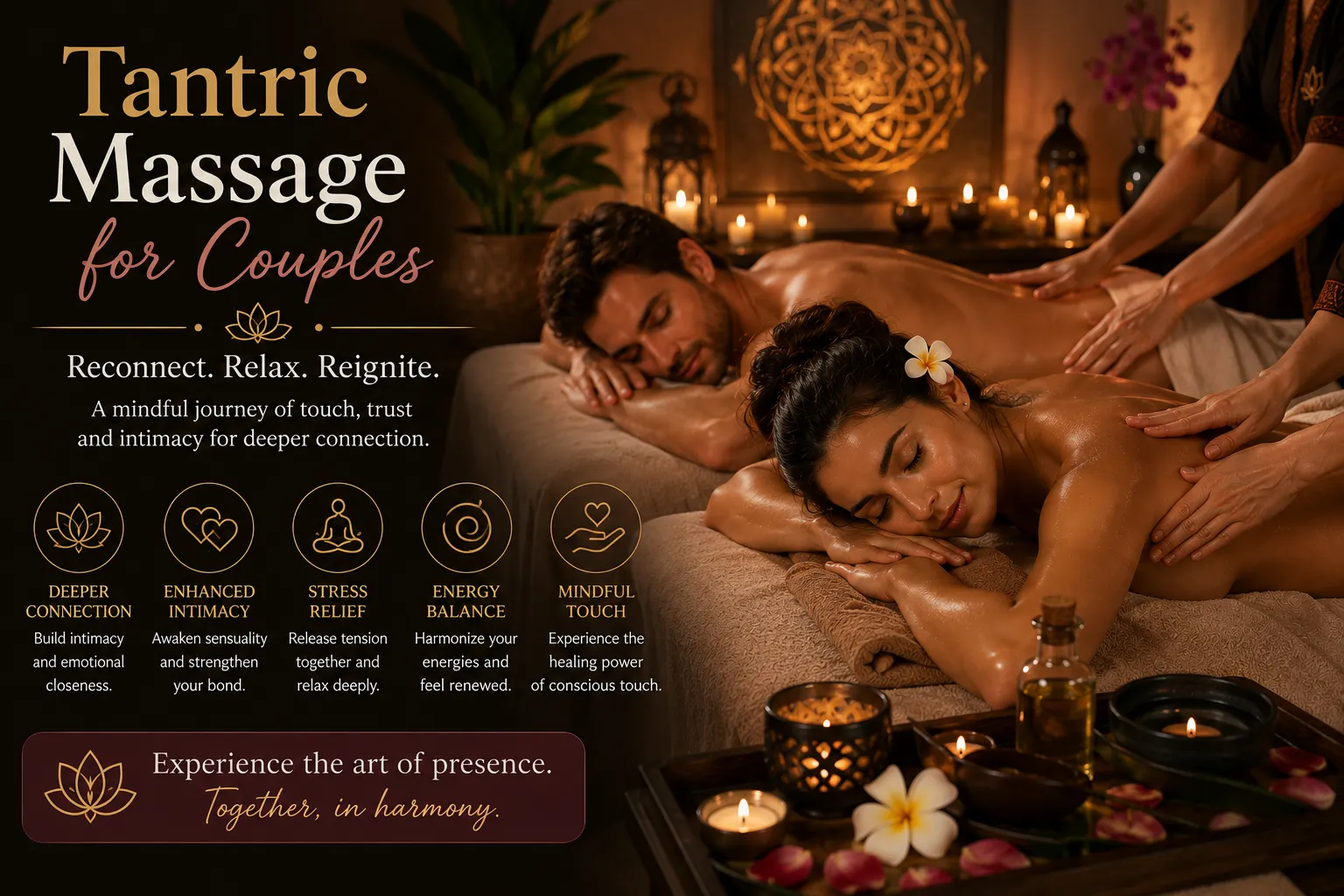
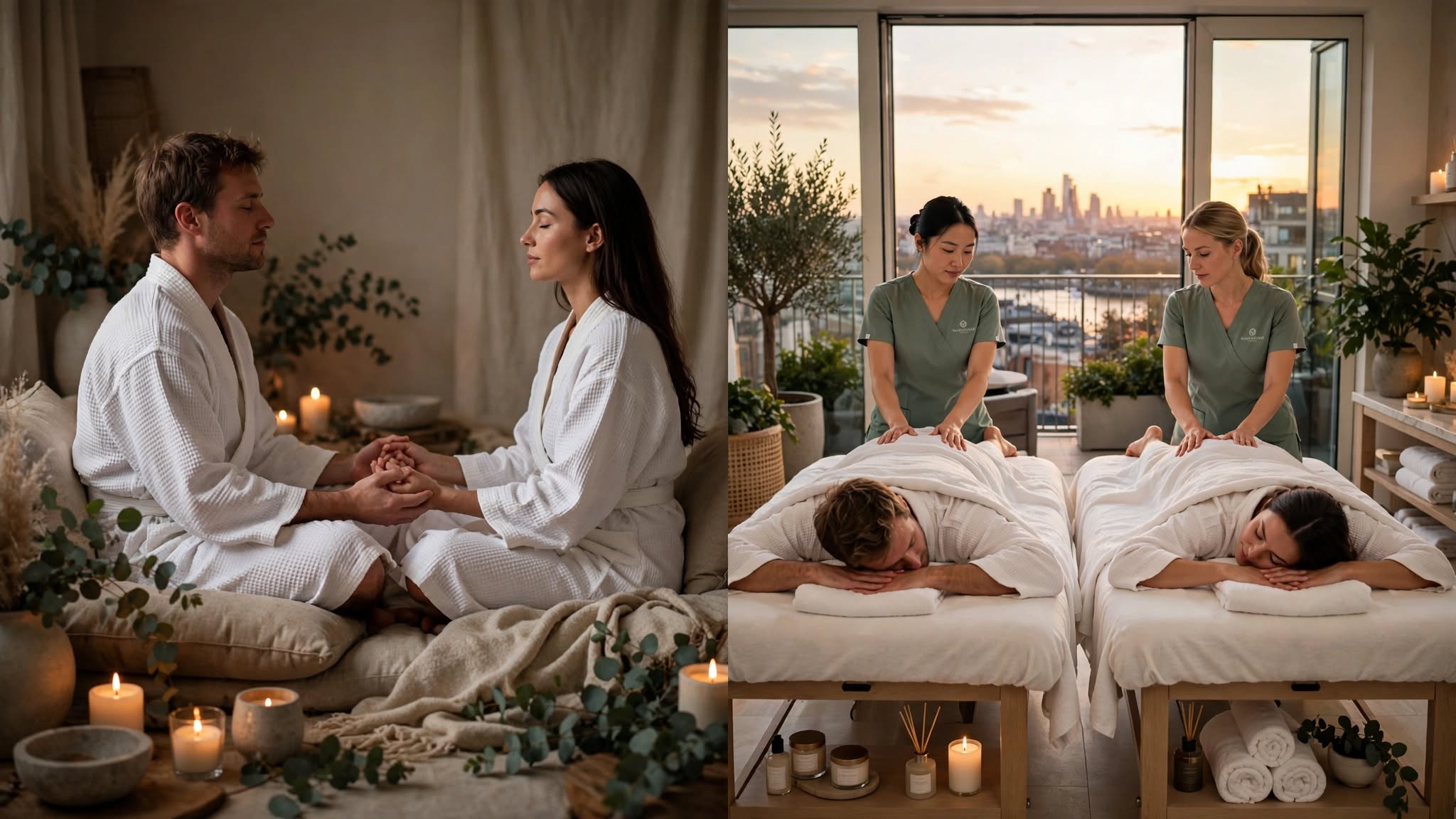
A couples tantric massage is a shared appointment for two consenting adults, usually arranged in the same private setting with professional therapists. The couple arrives together, but each person keeps control over their own preferences, boundaries and feedback. A well-planned session therefore creates togetherness without expecting identical pressure, pace, comfort or response from both partners.
London couples often have plenty of contact but very little uninterrupted time. Work, travel, phones and household tasks can turn an evening together into another exercise in coordination. Booking a shared massage creates a defined pause in that pattern, without requiring either partner to lead the experience.
That simplicity should not be confused with a guarantee. Massage cannot repair a relationship or manufacture closeness. It can provide a structured experience in which two people slow down together while remaining responsible for their own choices.
For couples considering Tantric Massage in London, the most useful question is not whether both partners will have the same journey. It is whether the provider can support two different journeys respectfully in one room. This guide explains how that works, what to discuss before booking and how to recognise a professional shared-session format.
Two journeys, one room
The phrase “couples massage” can suggest a perfectly synchronised experience. In practice, synchronisation is optional. One partner may prefer a quieter pace, while the other wants more frequent verbal check-ins. One may settle quickly, while the other needs extra time to become comfortable in an unfamiliar setting.
A strong couples session does not flatten those differences. It gives them a workable structure. Think of the appointment as two individual routes that share a setting, an agreed start and a gentle close. The people may hear the same music and occupy the same room, but each receives attention according to their own needs.
This idea can be organised through five stages:
- A shared intention for the appointment.
- Two individual preference maps.
- Clear room and therapist choreography.
- Independent signals for live adjustments.
- A considerate return to ordinary life.
These stages prevent one partner’s confidence, silence or preference from becoming the standard the other person is expected to follow.
Stage one: choose a shared intention, not a shared outcome
Before selecting a time or therapist, the couple should agree on the broad reason for booking. This intention provides direction without turning the appointment into a test.
A shared intention might be:
- to spend calm, phone-free time together;
- to mark an anniversary or private celebration;
- to try a new relaxation experience as a couple;
- to create an unhurried break during a London visit;
- to step away from a demanding period of work or travel.
An outcome is different. “We must feel closer afterwards” or “we should both relax completely” creates pressure. Neither person nor the therapists can promise a particular response. Tiredness, curiosity, quietness or simple rest are all valid.
The intention should belong to both people. A booking is not genuinely shared if one partner feels persuaded, tested or unable to decline. A surprise can be an invitation, but the appointment should be confirmed only after each adult understands the format and freely agrees.
The NHS explains consent in a clinical context as voluntary, informed and given by a person with capacity. Massage is not medical treatment, but those principles provide a useful ethical benchmark. Permission should not result from pressure by a partner, and a person who agreed earlier must still be able to change their mind.
Stage two: create two individual preference maps
Once the shared intention is clear, each partner needs space to describe their own comfort. This is where a couples appointment becomes personal rather than merely simultaneous.
A preference map does not need to be complicated. It can cover:
- preferred pressure and general pace;
- areas that need extra care or should be avoided;
- positioning, cushioning and temperature comfort;
- sensitivity to fragrance, oils or other products;
- preference for conversation, quiet or occasional check-ins;
- relevant health conditions, injuries, allergies or recent procedures;
- any personal boundary that affects the agreed session.
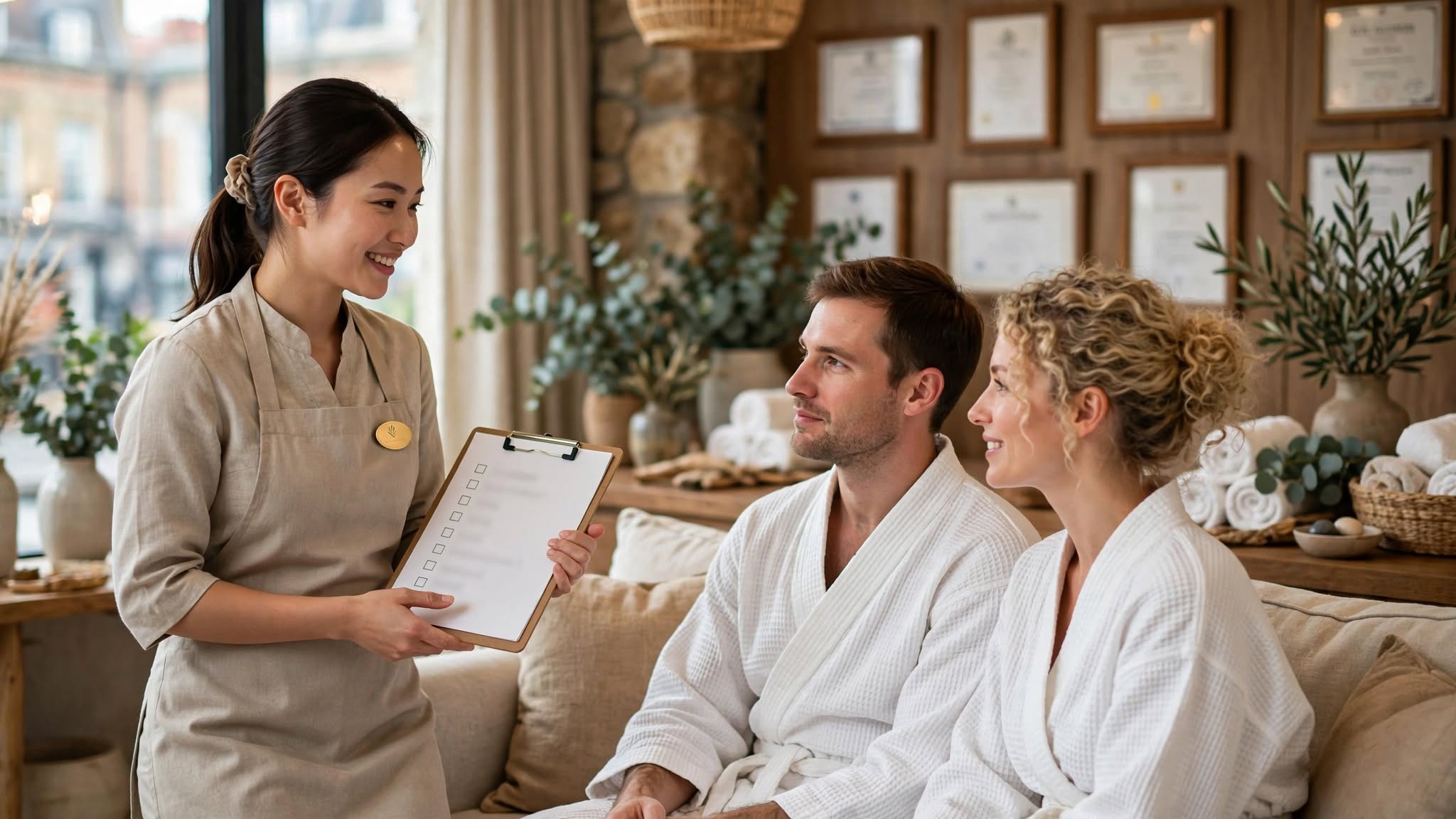
These answers should be gathered for each person, not negotiated as a single couple profile. “We like firm pressure” may conceal the fact that one partner merely agreed because the other answered first. A professional consultation gives both adults a real opportunity to speak.
The UK National Occupational Standard for body massage requires consultation, informed consent, privacy, hygiene and adaptation to the individual client. It also recognises that sequence, depth, pressure, products and positioning may need adjustment. Those requirements matter even more in a shared room because the therapist is working beside another client and practitioner.
Private information can remain private
Couples do not need to disclose every health detail to each other. Ask whether each person can complete their own consultation or speak privately. A partner’s presence should not remove ordinary confidentiality.
The therapist needs enough information to decide whether the appointment can proceed and whether modification is required. The other partner does not automatically need the full explanation.
Stage three: understand the session choreography
“Same room” describes a location, not the complete service format. Couples should know who will be present, how the room is arranged and whether both sessions begin and finish together.
The most straightforward format usually involves two clients and two therapists. This gives each person dedicated professional attention and makes independent pacing easier. However, exact arrangements vary, so they should be confirmed before payment or travel.
Useful questions include:
- Will two therapists be present throughout?
- Will both clients be in the same room?
- Are there two separate massage tables or another arrangement?
- Is consultation time included in the booked duration?
- Can either person request a pause without ending the other session?
- What privacy and changing arrangements are provided?
- Which products are used, and are alternatives available?
- What happens if a therapist or room arrangement changes?
A clear provider should be able to explain the actual format in ordinary language.
The couples massage service page outlines the offered format, while the therapist directory supports individual selection. Confirm current pairings, location and availability directly because operational details change.
Parallel attention does not require identical technique
Two therapists may begin at approximately the same time without copying every movement. Exact mirroring can look appealing as an idea, but it may ignore differences in body position, pressure preference and comfort. Responsive work is more important than visual symmetry.
One side of the room might become quieter while the other includes a brief conversation about pressure. One person may need a cushion or temperature adjustment. These small differences are signs of individual care, not evidence that the couple has become disconnected.
Stage four: use independent adjustment signals
Consent is not a single statement made at the beginning. It remains active throughout the appointment. Each client should know how to ask for a change and trust that the request will be received without irritation or persuasion.
Simple phrases are enough:
- “Please reduce the pressure.”
- “Could we slow the pace?”
- “I would like a cushion under my knees.”
- “Please avoid that area.”
- “I need a short pause.”
- “I am comfortable to continue.”
- “I would like to stop.”
The wording does not need to sound elegant. It only needs to be clear. A therapist may also check comfort verbally, especially after a change of position or technique. Silence should never be treated as unlimited permission.
Partners can support each other by not answering on the other person’s behalf. Even a well-meant “they are fine” can make it harder for someone to express a different view. The therapist should direct questions to the client concerned and accept that person’s answer.
A pause does not have to become a couple decision
If one person wants to pause, the provider should follow the agreed plan for that situation. Depending on the room and service format, the other person may be able to continue. This should be discussed beforehand rather than improvised when someone is already uncomfortable.
Stopping should also remain available. Earlier agreement, payment or a partner’s enjoyment does not remove that option. NHS consent guidance states that a person may withdraw previous consent before a procedure. In a professional massage setting, the practical principle is equally important: consent can change, and the session must respond.
Breath and attention without performance
Some couples associate tantric practice with slow breathing and focused awareness. These elements can be included gently, but they should never become another demand to synchronise perfectly.
Comfortable breathing may help a person notice whether they are bracing, rushing or holding tension. The aim is observation, not breath control. If counting breaths feels awkward, creates light-headedness or makes someone anxious, ordinary breathing is the better choice.
Tantra Yoga may include breath, movement, meditation or philosophical practice depending on the teacher and tradition. It is not the same as receiving a professional massage, and a massage appointment should not imply that it provides yoga instruction unless that is genuinely part of the stated service and the practitioner is appropriately trained.
A couple can share attention without matching every inhale. A softer room, fewer phone interruptions and an unhurried pace may be enough. The valuable moment is not perfect unison. It is each person noticing their own experience while respecting the other’s.
Stage five: return to the day without comparing results
The appointment does not end emotionally the moment the booked time finishes. A short, calm transition can help both people leave without turning immediately to evaluation.
One partner may want to talk. The other may prefer quiet and a few minutes to get dressed. Neither response is more appreciative. Couples can delay detailed discussion until they are outside the treatment setting.
A useful first conversation is descriptive rather than comparative:
- “What part helped you settle?”
- “Was anything different from what you expected?”
- “Is there something you would change next time?”
- “Would you like to talk now or later?”
Avoid asking who relaxed more, whose therapist was better or whether both people experienced the same degree of connection. Those questions turn private responses into scores. The shared value of the appointment does not depend on equal reactions.
London travel affects the ending. When possible, leave a small buffer instead of rushing to a Tube connection, work call or another timed commitment.
How a couples session differs from relationship therapy
A shared massage and relationship therapy have different purposes, methods and professional boundaries. Confusing them can create unrealistic expectations.
Massage may offer restful time in the same setting. It does not assess relationship patterns, mediate conflict, treat trauma or provide clinical advice. Therapists should not interpret a client’s physical response as evidence about the health of the relationship.
If a couple is dealing with persistent conflict, coercion, fear, betrayal or a serious communication breakdown, a massage appointment is not an appropriate substitute for qualified support. It may also be better to postpone a shared session if either person is using it to avoid a necessary conversation.
The healthiest booking intention is modest and honest: “We would like to share a professionally organised experience while keeping our own choices.” That expectation can be met through good planning. “This must fix what is wrong between us” cannot.
Choosing a professional London provider
Provider selection should focus on observable standards. Polished language and atmospheric photographs can be appealing, but they do not explain how two clients will be consulted, protected and supported.
Even the most popular Tantric Massage parlour in London should be able to answer basic questions about privacy, hygiene, therapist roles, boundaries, products, room layout and what happens if one person wants to pause. Popularity never replaces a clear process.
For some couples, the best tantric studio in London will be the one that explains these details before taking the booking, respects separate preferences and avoids promising a guaranteed emotional or relationship result. Suitability is personal, but professionalism can be checked.
Look for the following signs:
- service descriptions that state who the appointment is for and how it is arranged;
- a consultation process for both clients;
- transparent boundaries and adults-only expectations;
- clean materials and a clear hygiene process;
- privacy during consultation, changing and the session;
- realistic wording that does not promise healing or relationship repair;
- a direct route for asking questions before booking;
- clear information about duration, pricing, location and changes.
The frequently asked questions can help first-time visitors identify practical points to clarify. Where the website and booking message appear inconsistent, ask for confirmation in writing.
Incall and outcall considerations for two people
The right setting depends on privacy, travel and the provider’s current couples format. Couples should compare the practical environment rather than assuming one option is always more intimate or convenient.
An incall appointment may offer a prepared room and separation from home responsibilities. Confirm the address area, arrival procedure and whether the room supports the stated arrangement.
An outcall appointment may reduce travel or suit London visitors. The couple must provide adequate space, privacy, access and uninterrupted time. Hotel visitor policies and room limitations need checking.
For either format, confirm arrival, preparation time and service availability for the specific date and address.
Preparing as a couple without overplanning
Good preparation removes uncertainty, but an elaborate script can create its own pressure. Concentrate on decisions that affect comfort and logistics.
Several days before
Make sure both adults have seen the service information and agreed freely. Share allergies, relevant conditions and accessibility needs. Confirm the location, duration, therapist arrangement, products and payment process.
If either person has an acute injury, unexplained symptoms, a contagious condition, a recent procedure or a health concern that may affect massage, disclose it before attending. The provider may need to adapt, postpone or recommend medical advice. Massage should never be used to delay appropriate healthcare.
On the day
Allow enough travel time to avoid a sprint across London. Wear easy-to-change clothes, follow ordinary personal hygiene and avoid new fragranced products if skin sensitivity is possible.
Keep food, alcohol and substances out of the decision-making process. Both clients need to be able to understand the agreed format, communicate clearly and make voluntary choices. If either person no longer wants the session, contact the provider rather than treating attendance as an obligation.
During consultation
Let each person answer for themselves. Confirm areas to avoid, pressure preferences, product sensitivities and the signals for pause or stopping. Ask what will happen if one person needs more time or requests a change.
The goal is not to remove every unknown. It is to make sure the important choices remain visible and available.
When booking together may not be the right choice
A couples session is optional, not a milestone every partnership should pursue. Separate appointments or a different shared activity may be more comfortable.
Consider another option when:
- one person is reluctant or agrees mainly to prevent disappointment;
- the booking is intended to test trust, attraction or loyalty;
- either partner expects identical responses;
- unresolved conflict is likely to make the shared room uncomfortable;
- privacy needs cannot be met in the available setting;
- a relevant health issue has not been assessed;
- the provider cannot explain consent, boundaries or therapist roles clearly.
Choosing not to book is a valid decision. So is starting with individual appointments, asking more questions or selecting a simpler relaxation activity. A respectful experience begins before anyone enters the room.
Frequently asked questions
These questions address the practical uncertainties couples often have before arranging a shared appointment.
Do we need to want the same style of massage?
No. A couples session can involve different pressure, pace, positioning and communication preferences for each person. Confirm in advance that the therapist arrangement allows independent adaptation rather than requiring an identical sequence.
Can one person be more nervous than the other?
Yes. Familiarity and comfort often differ. The more confident partner should avoid speaking for the other or pushing them to “relax”. A clear consultation, unhurried start and genuine ability to pause are more useful than reassurance alone.
Should a couples massage be booked as a surprise?
The invitation can be a surprise, but the confirmed appointment should not be. Both adults need enough information to decide freely, share relevant health details and agree to the format. A voucher or proposed date can preserve the gift while leaving room for consent.
Do both sessions have to begin and end together?
Not necessarily. Providers arrange timing differently, and one client may need an adjustment or pause. Ask whether consultation is included, how the therapists coordinate and what happens if one person stops early.
Can we talk during the appointment?
That depends on personal preference and the provider’s format. Some couples enjoy quiet; others appreciate a brief check-in. Agree that either person may ask for less conversation without the request being taken personally.
Is couples tantric massage suitable for a relationship problem?
No. It is not relationship therapy or a way to resolve conflict. Concerns requiring structured communication, assessment or clinical support belong with an appropriately qualified professional.
What should we ask before paying?
Confirm the number of therapists, room arrangement, duration, price, location, products, consultation, privacy, boundaries, cancellation terms and how independent changes are handled. Keep the written confirmation so both partners arrive with the same practical information.
Togetherness without sameness
The strongest couples massage is not a performance of perfect harmony. It is a professionally supported experience in which two adults can share time without surrendering individuality.
The “two journeys, one room” approach makes that possible. Begin with a mutual intention. Map preferences separately. Confirm the room and therapist roles. Keep live adjustments available to each person. End without comparing results. Those choices give the appointment a respectful structure and leave room for genuine, unforced experience.
If you and your partner would like to explore the current format, review the couples massage options and contact Tantric Massage London to confirm therapist arrangements, location and availability before booking.
Sources
The professional and consent safeguards in this article draw on the following primary guidance.






Leave a Reply