

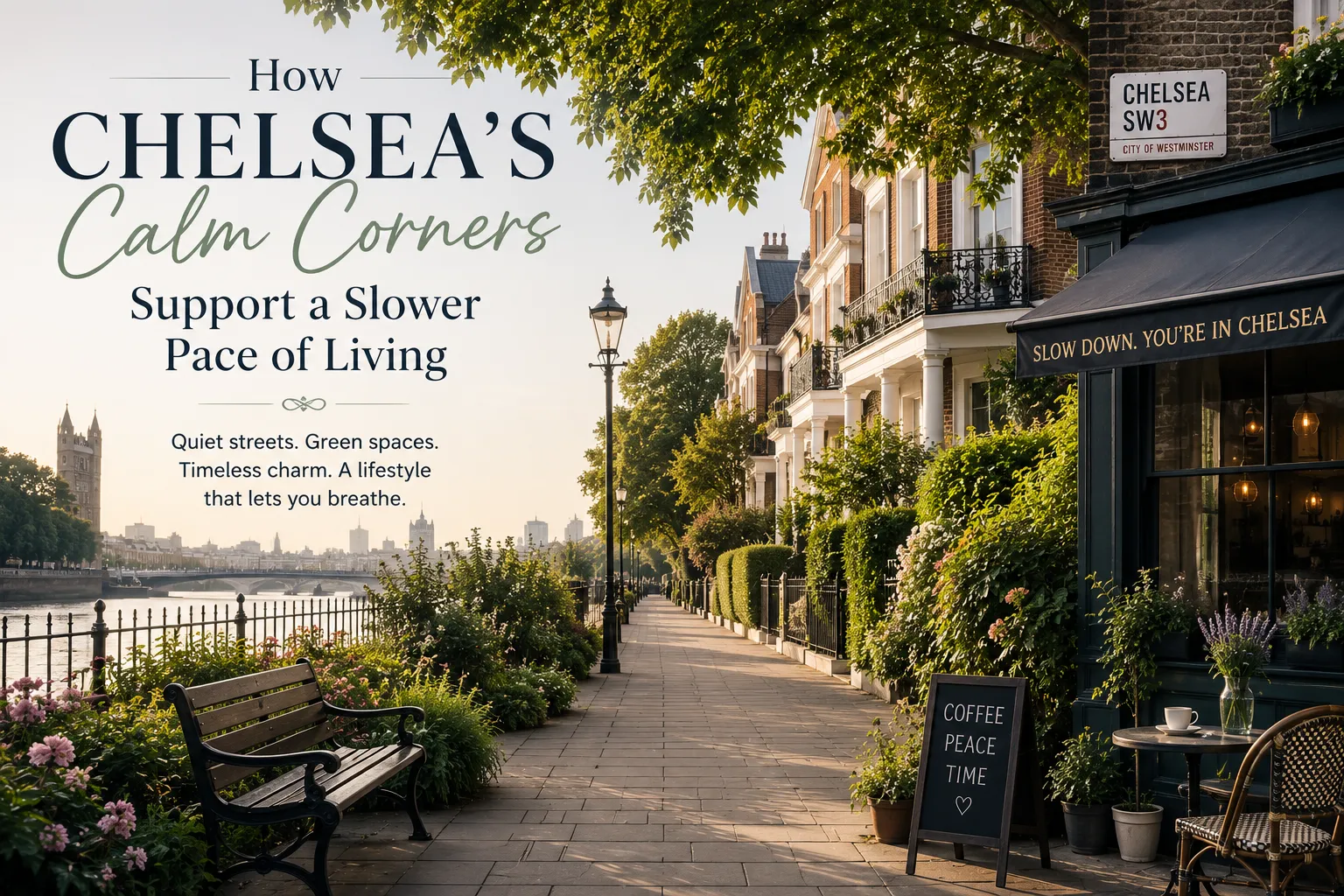
Chelsea supports a slower pace of living by placing riverside walks, planted streets, cultural spaces and quiet places to pause within a well-connected part of London. The area is not silent, but its varied surroundings make it easier to move between activity and rest without organising a journey outside the city.
For residents, professionals and visitors, the value of Chelsea lies in these small changes of atmosphere. A busy stretch of King’s Road can lead towards a residential street. A demanding afternoon can finish beside the Thames. A free hour can be spent in a garden, over an unhurried meal or at a carefully arranged wellness appointment.
This approach to wellness in Chelsea London does not depend on expensive routines or an empty diary. It starts with choosing fewer activities, walking at a comfortable pace and noticing which surroundings help the mind move away from constant urgency.
A slower life in Chelsea is therefore built through repeatable decisions. Take the quieter route when time allows. Leave space between appointments. Use local green areas responsibly. Select one restorative activity rather than trying to fit several into the same evening. These choices may appear modest, but together they can change how a day feels.
Chelsea offers contrast rather than complete quiet
Chelsea remains an active Central London neighbourhood, so its calmer character should not be confused with total silence. Its strength comes from the contrast between lively streets and more settled spaces nearby.
King’s Road contains shops, cafés, galleries and steady pedestrian movement. Sloane Square can become busy around commuting and performance times. Traffic along major routes is part of daily life. Yet a short change of direction can reveal tree-lined residential streets, smaller terraces or a view towards the river.
That variation gives people a practical way to regulate the pace of a day. Someone leaving a crowded café does not necessarily need to travel home immediately. A short walk along a less commercial street may provide enough separation before the next commitment.
The important point is to stop expecting one place to create an instant emotional change. A calm corner works best when the person using it also changes behaviour. Walking more slowly, putting away the phone and allowing ten minutes without another task can make an ordinary setting feel more restorative.
Many attractive garden squares are private communal spaces. The Royal Borough of Kensington and Chelsea explains that access is usually restricted to residents of the surrounding properties. Admire them from public streets and use public parks, riverside routes or ticketed gardens when planning a pause.
The river creates a natural change of rhythm
The Thames gives Chelsea a visual boundary that feels different from the retail and residential streets further north. Moving towards the water can mark a deliberate transition in the day.
The Thames Path follows both banks of the river through London, and Transport for London includes Albert Bridge among the sights along the route. A person does not need to complete a formal section to benefit from the setting. A short, familiar stretch can be enough.
Water, open sky and long sightlines give the eyes a break from shop windows and close building fronts. The river also makes it easy to choose a direction rather than repeatedly checking a map.
Keep the walk flexible. Weather, lighting, construction, crowds and personal mobility can affect the experience. Check the route, remain aware of other path users and turn back when it stops feeling comfortable.
Leaving headphones off for part of the route can reduce the stream of information. The purpose is not to reach a distant landmark, but to create an interval between what came before and what follows.
Chelsea Physic Garden rewards patient attention
A contained garden offers a different form of calm from an open riverside route. It encourages close observation rather than distance or speed.
Chelsea Physic Garden sits beside the Thames and describes itself as a four-acre garden with a living collection of edible, useful, medicinal and historical plants. It is a ticketed attraction with stated visiting hours, so current opening information and admission arrangements should be checked before travelling.
The garden suits a slower visit because its value is found in detail. Reading one label carefully, noticing how plants are grouped or sitting without attempting to cover every section can be more satisfying than rushing through the complete collection.
Visitors can turn a peaceful destination into another item to finish by photographing every display or following a strict route. A slower approach accepts that part of the garden may remain unexplored and leaves a little time afterwards before the next commitment.
Residential streets can turn walking into a daily practice
Not every slower routine needs a formal destination. Chelsea’s public residential streets can support short walks that fit around work, errands and home life.
A useful neighbourhood walk is easy to repeat. It begins and ends at familiar points, avoids unnecessary crossings and can be shortened when the weather changes. The route does not have to include a famous building or public attraction.
Repetition can make the walk more valuable. When directions are known, there is less need to use a phone, and small seasonal changes become easier to notice.
Choose public routes and respect the privacy of residents. Do not enter gated gardens, private courtyards or shared residential spaces simply because they appear peaceful. Calm living should not depend on disrupting someone else’s home environment.
For someone who works nearby, a fifteen-minute loop after lunch may be more sustainable than an ambitious plan that rarely fits the day. Keep belongings secure, use proper crossings and remain attentive to traffic and changing pavement conditions.
Cafés can be used as pauses, not temporary offices
Chelsea has many places to eat and drink, but a café only becomes restorative when it is used differently from the office or commute.
Choose a venue according to comfort rather than appearance alone. Seating, noise, queue length, lighting and distance from the next destination affect whether a break actually feels like a break.
Once seated, place the phone away after dealing with essential messages. Avoid opening a laptop for a task that can wait. Drink slowly enough to notice temperature and taste, and allow hunger to guide the choice of food rather than selecting automatically.
Remote workers can set a clear boundary: complete one planned task, close the computer and pause before leaving. An unhurried meal can also protect the evening. If movement, yoga or massage is planned later, choose comfortable food and allow suitable time before the next activity.
A venue’s reputation does not guarantee calm. A convenient café with available seating may serve the purpose better than a fashionable location with a long queue.
Slower living depends on leaving gaps in the diary
Chelsea’s calm corners are most useful when there is enough time to notice them. A schedule filled to the minute turns even short journeys into sources of pressure.
Leave realistic gaps between work, meals, cultural visits and private appointments. The buffer does not have to be large, but it should account for walking, finding an address, using a cloakroom or responding to a transport change.
A practical diary can include three types of time:
- Fixed time for appointments that cannot move
- Flexible time for walking, food or quiet observation
- Empty time that absorbs delays or changes in energy
This structure helps visitors unfamiliar with local distances. A route that looks short may take longer with bags, poor weather or crowded pavements. Slower living gives each activity enough space to receive attention.
A simple digital boundary protects local calm
Phones make Chelsea easier to navigate, but they can also carry work, news and social comparison into every quiet setting. A realistic boundary preserves practical access without demanding a complete digital detox.
Before leaving, save the route, booking confirmation and any information needed for the next destination. Charge the phone and keep important contact details easy to find. Then silence non-essential notifications.
Avoid scrolling while walking, eating or sitting beside the river. These three situations account for a large amount of accidental screen time and reduce awareness of the surroundings.
Taking photographs is not a problem, but evaluating every view for posting keeps attention on the screen. Take one or two meaningful images, respect local rules and then put the device away.
If an appointment has been arranged, keep the confirmation available. Do not switch the phone off if the provider may need to communicate an essential access update.
The aim is to ensure that a calm corner remains separate from the information stream that filled the rest of the day.
A short yoga routine can create a quiet transition at home
A slower Chelsea routine does not always require leaving the house or hotel. Familiar movement and attentive breathing can create a useful transition between the working day and the evening.
Tantra Yoga may involve mindful attention, breath and deliberate movement. For a short personal routine, simplicity is safer and more sustainable than attempting an advanced sequence in an unfamiliar space.
Check that the floor is clear and stable. Wear comfortable clothing and use only postures that have already been learned appropriately. A person who has spent the day at a desk might choose gentle movements followed by a seated pause, while someone returning from a long walk may prefer stillness.
Do not force deep breaths, difficult positions or extended holds. Stop if there is pain, dizziness, breathlessness or instability. Beginners and people with relevant health concerns should seek guidance from a suitably qualified teacher or healthcare professional.
Yoga should not be presented as a guaranteed treatment for anxiety, pain, fatigue or another health condition. Here, its role is to give the evening a clear beginning and direct attention away from unfinished tasks.
Professional massage can become the day’s main restorative activity
Some adults may choose a professionally arranged massage instead of a walk, garden visit or yoga routine. It works best as the principal activity rather than one item in an overcrowded evening.
Anyone considering Tantric Massage in London should read the complete service description and confirm what the appointment involves before travelling. Similar terminology may be used differently by different providers, so a title alone is not enough.
Tantric Massage London currently lists Chelsea SW3 on its location page and maintains a dedicated Chelsea page. A listed location does not confirm that a particular therapist, time or appointment format is available. Current details should be checked directly.
A clear enquiry should confirm:
- Whether the appointment is incall or outcall
- The therapist currently available
- The general location and arrival process
- The agreed duration and complete price
- The accepted payment method
- Hygiene and preparation expectations
- How comfort and boundaries will be discussed
- Cancellation, lateness and hotel-access arrangements
The conversation should reduce uncertainty. If the setting, therapist or price remains unclear, ask for a direct explanation before committing time or money.
Choose a provider through evidence, not a headline
Comparing private wellness providers can be difficult because promotional claims often sound similar. Practical information gives a stronger basis for a personal decision.
Someone seeking the most popular Tantric Massage parlour in London still needs to determine whether its location, communication and appointment format suit their circumstances. Popularity alone cannot establish comfort, professionalism or individual suitability.
Look for a complete booking pathway. Current therapist information, understandable service descriptions, transparent durations and responsive communication all help a client know what has been arranged.
The best tantric studio in London for one person may be unsuitable for another. A Chelsea resident may prioritise a nearby incall option, while a hotel guest may care more about outcall coverage and visitor access. A first-time client may need additional explanation before choosing a therapist.
Useful evidence includes respectful answers, clear hygiene expectations, a consultation, equal regard for boundaries, realistic language and reliable arrival instructions. These factors cannot create a universal ranking, but they can help a client choose without relying on an unsupported superlative.
Incall and outcall options create different kinds of convenience
The appointment setting affects privacy, travel and the pace of the time afterwards. The more convenient format depends on the client’s accommodation, schedule and preferences.
An incall appointment takes place at the provider’s stated location. It may help someone create a firm boundary between work, home and personal time. Confirm the arrival procedure, because a private setting may not accept unannounced or substantially early visitors.
An outcall appointment takes place in suitable private accommodation. This can reduce travel, but the building must permit visitors, the room must offer appropriate space and privacy, and any travel charge should be agreed in advance.
Hotels use different reception and security procedures. Check the visitor policy before booking and never ask a therapist to avoid legitimate access requirements. Give accurate location details so that neither person is left waiting.
Incall requires a return journey, while outcall allows the client to remain in the room. Whichever format is chosen, avoid scheduling an immediate work call afterwards. Convenience is the option that removes avoidable uncertainty from the complete experience.
Privacy, hygiene and consent support a calm appointment
A private wellness experience cannot feel settled when basic expectations remain unclear. Professional preparation begins before arrival and continues throughout the appointment.
Privacy starts with the first enquiry. Share information reasonably required for communication and access, and follow the confirmed arrival instructions rather than waiting outside a private address.
Hygiene guidance should be straightforward. Arrive clean, sober and in comfortable clothing. Allow enough time after a meal to feel at ease. If the provider’s preparation requirements are unclear, ask before the appointment.
Mention injuries, recent procedures or health concerns that could affect safe positioning. Seek qualified medical advice if there is uncertainty about whether massage is appropriate.
A consultation should confirm the service, comfort considerations and boundaries. Consent remains active throughout. A client may ask to pause, adjust or stop, and the therapist’s boundaries must be respected equally.
Photographs, recordings and the sharing of private messages should never be assumed to be acceptable. Discretion is a mutual responsibility, not merely a promise made by the provider.
Build a slower Chelsea day around one anchor
A workable plan uses one main activity as the anchor and lets everything else support it. This prevents a restorative day from becoming another complicated project.
Morning: begin before the streets become the agenda
Start with breakfast at home, in the hotel or at a convenient café. Check essential travel details once and decide on the day’s main activity.
If the weather is suitable, take a short public route through residential Chelsea or towards the river.
Late morning: give attention to one place
Choose a ticketed garden, cultural visit or defined stretch of walking. Confirm opening information and leave while concentration remains comfortable.
Afternoon: create a genuine pause
Eat without rushing and keep the phone away from the table when practical. Leave an open interval after lunch for weather changes, tiredness or an unplanned rest.
If a professional appointment is the anchor, confirm the route, preparation and arrival instructions.
Evening: protect the transition
Choose one activity, such as a familiar yoga routine, a quiet dinner, reading or a confirmed massage appointment. Avoid trying to include all four.
Afterwards, take a straightforward route home or remain at the hotel. Reopening work messages immediately can restore the pace the day was intended to interrupt.
Frequently asked questions
These answers address practical questions about creating a slower routine in Chelsea and arranging local wellness time.
Chelsea is not consistently quiet. King’s Road, Sloane Square and major roads can be busy. Its appeal lies in the quick transitions available between commercial streets, public riverside routes, cultural settings and calmer residential surroundings. Choosing the time and route carefully matters more than expecting silence.
Where can I take a calm walk in Chelsea?
The Chelsea stretch of the Thames offers a useful public walking option, with Albert Bridge providing a recognisable reference point. Check current route conditions, weather and lighting before setting out. Public residential streets can also support shorter walks, but private garden squares and courtyards should not be entered without permission.
Can I visit Chelsea Physic Garden without planning?
It is better to check first. Chelsea Physic Garden is a ticketed attraction with published opening times and admission arrangements that may change. Review its official visitor page before travelling, especially during seasonal closures, special events or periods when timed entry may apply.
Which Tube station is useful for Chelsea?
The most suitable station depends on the exact destination. Sloane Square is in Zone 1 and is served by the Circle and District lines. South Kensington and other nearby connections may suit different parts of Chelsea. Use current Transport for London journey information rather than relying on one station for every address.
How much should I plan for a slower day?
Choose one main activity and one or two flexible supporting pauses. Save essential routes and reservations, but leave gaps for food, walking and delays. An open interval is part of the plan, not wasted time.
Should a private massage appointment be booked in advance?
Yes. Confirm the therapist, appointment format, location, duration, price, payment method, preparation and arrival procedure before travelling. A location shown on a website does not prove availability for a particular time.
Can yoga, walking or massage treat stress?
These activities may form part of personal relaxation time, but they should not be presented as guaranteed treatments for stress, anxiety, pain or another health condition. Experiences vary. Persistent or concerning symptoms require advice from an appropriately qualified healthcare professional.
Let Chelsea’s quieter moments shape the day
Chelsea supports slower living through contrast. Its active streets provide convenience and interest, while the Thames, planted environments, cultural spaces and public residential routes offer opportunities to change pace without leaving London.
The most useful calm corner is often the one that fits naturally into the day. It may be a familiar stretch beside the river, a table where the laptop stays closed or a quiet interval before a confirmed appointment. Its value comes from how it is used.
Choose fewer activities, leave space between them and confirm practical details before travelling. Respect private spaces, protect digital boundaries and allow the main restorative activity to stand on its own.
To review current Chelsea location information and explore appointment pathways, visit Tantric Massage London.





Leave a Reply