

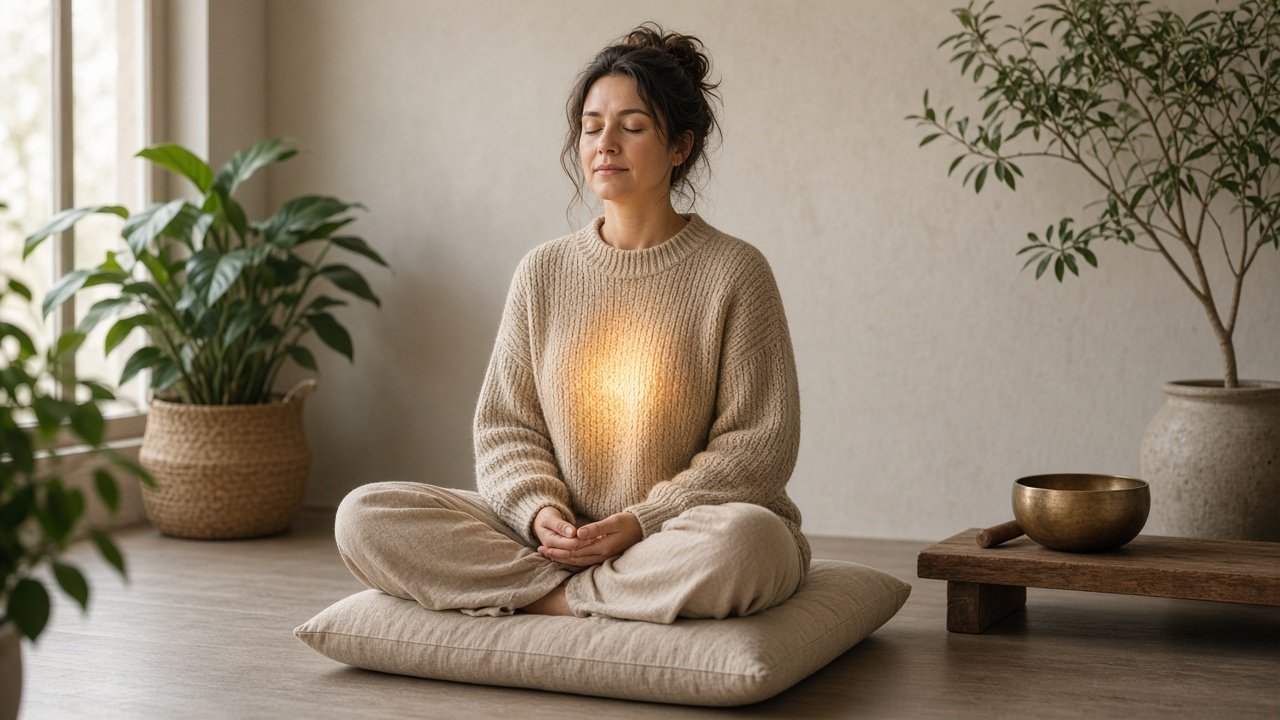
Chakra meditation is one of the most popular ways people encounter Tantric ideas. A teacher invites you to close your eyes, imagine a spinning wheel of coloured light at the base of the spine, then move upward through the body. Done well, the practice can be a calming and engaging way to train attention. Done carelessly, it can turn into a checklist of colours and claims that adds more noise than clarity.
This article presents a set of chakra meditation techniques inspired by Tantra Yoga, from very simple to more elaborate, with guidance on pacing, safety and adaptation. They are secular, beginner-friendly versions, not initiated lineage practices. Where traditions differ, the article says so, and it avoids health or supernatural claims.
Before you begin
What the practice is for
The chakra system is a map of attention along the central axis of the body. A standard encyclopedia account notes that Tantrism developed an esoteric anatomy of energy centres connected by channels and that this anatomy is visualised in Tantric yoga. In modern practice, chakra meditation is used mainly to train steady attention, body awareness and reflection on themes such as stability, feeling, energy, connection, expression, insight and openness.
What it is not
It is not a medical treatment. It is not a test of spiritual development. It is not a way to read people’s characters. And it is not a practice you must do to benefit from Tantra Yoga.
Preparation
- Choose a quiet place and a comfortable seated or lying posture.
- Avoid practising immediately after a heavy meal or when extremely tired.
- Plan for ten to twenty minutes, and begin with less if you wish.
- Keep a glass of water nearby.
- Decide in advance that you may stop at any time.
Technique 1: Simple body-location meditation
This is the most basic form and a good starting point.
- Sit comfortably. Take three slow breaths.
- Rest attention at the base of the spine for four or five breaths. Notice contact, weight and any sensation.
- Move attention up through the remaining locations in turn: lower belly, upper belly, centre of the chest, throat, forehead, crown. Spend four or five breaths at each.
- Let attention widen to the whole body.
- Close with a deeper breath.
There is no visualisation, no colour and no sound, only attention and sensation. Many people find this version the most grounded.
Technique 2: Breath-linked ascent and descent
Here the breath guides movement through the centres.
- Settle and take three natural breaths.
- Begin at the base. On each inhale, let attention rise slightly along the spine. On each exhale, let it settle.
- Over successive breaths, let attention climb gradually, one centre every few breaths, until it reaches the crown.
- Rest for a few breaths at the crown.
- Descend in the same way, letting each exhale carry attention back down to the base.
- End by resting at the lower belly or the whole body.
Keep the breath natural and easy. Do not hold or force it.
Technique 3: Colour and light visualisation
Many modern teachers use colours for the centres, commonly red at the base, orange at the lower belly, yellow at the upper belly, green at the chest, blue at the throat, indigo at the forehead and violet or white at the crown. This rainbow scheme is largely a modern convention, and some traditions use different colours or none. If colours help you, use them. If they feel forced, skip them.
- Settle with a few breaths.
- At each location, imagine a soft glow of the associated colour, as though a small lamp were lit there.
- Hold the image lightly for several breaths, noticing whether it feels warm, still or moving. If it fades, let it fade. If the image does not come at all, simply feel the area.
- Move on to the next centre.
- At the end, imagine the colours merging into soft white light filling the body, then let the image go.
Keep the imagery gentle. If it becomes intense, disturbing or tiring, return to simple body sensation. Visualisation is a skill that many people find difficult at first, and that is completely normal.
Technique 4: Sound and humming
Tantric traditions assign seed sounds to centres, such as LAM, VAM, RAM, YAM and HAM for the lower five, and OM for the upper. These are traditional associations used in mantra practice, and details vary by lineage. A simple secular version uses humming.
- Settle and take a breath.
- At each location, hum quietly on a comfortable pitch, letting the vibration be felt around that region. Lower pitches tend to resonate lower in the body, higher pitches higher.
- Spend three or four exhales at each centre.
- After the final hum, sit in silence for a minute and notice the aftereffects.
If you wish to use the traditional seed sounds, learn them from a qualified teacher, since pronunciation and context matter in the tradition. A modern summary of the Kashmiri tradition describes mantra as reflexive speech, sound that traces its way back to the silence from which it arises, which is a helpful way to approach any sound practice: listen all the way into the silence.
Technique 5: Element-based reflection
The lower five centres are traditionally linked to the five elements: earth, water, fire, air and space. A reflective practice can use them as themes.
- At the base, feel weight, solidity and support.
- At the lower belly, feel fluidity and softness.
- At the upper belly, feel warmth and energy.
- At the chest, feel breath and movement.
- At the throat, feel openness and vibration.
Spend a minute at each, noticing how the associated quality shows up in the body. This links chakra meditation with direct sensory experience and avoids heavy imagery.
Technique 6: Single-centre focus
Rather than moving through all seven, spend a whole session with one centre. This can be a more rewarding way to work, particularly if you are interested in a particular theme.
- Choose a centre and a theme, such as steadiness for the base or connection for the heart.
- Rest attention at the location and breathe gently.
- Reflect quietly on a question connected to the theme: “Where do I feel supported?” or “Whom do I feel close to?”
- Notice sensations, memories or thoughts that arise, without following them far.
- Close with a few breaths and, if you like, a brief written note.
Technique 7: Walking chakra meditation
For people who find sitting difficult, a walking version can work.
- Walk slowly in a quiet space.
- With each step, bring attention to the feet and legs (base).
- After a few minutes, shift to the belly and the sway of the pelvis.
- Then to the chest and breath, then the shoulders and arms, the neck and throat, the face and the crown.
- End by standing still and feeling the whole body.
Technique 8: Short daily check-in
On busy days, a thirty-second version can keep the habit alive. Pause, take a breath, and ask which of the seven themes is most needed now: steadiness, flow, energy, connection, expression, clarity or openness. Take one small action in that direction.
Technique 9: Journaling after practice
Writing for three to five minutes after a session turns a pleasant experience into usable information. Useful prompts include: Which location was easiest to feel? Which was hardest? Did any theme stir a memory or emotion? What was my state before and after? Over several weeks you may notice that certain centres consistently draw your attention or leave you flat. This is a prompt for reflection, not a diagnosis, but it can show you where your attention habitually goes and where it avoids.
Adapting the practice to your circumstances
Chakra meditation can be adjusted for almost any situation. If you are short of time, do a single centre for two minutes. If you have limited mobility, practise lying down or seated in a chair, and keep the movements imaginary. If you are in a noisy environment, use headphones with soft ambient sound or choose a technique based on breath and sensation instead of silence. If you share a home, a brief practice with eyes closed on a bus or train is perfectly possible. The framework serves you; you do not have to serve the framework.
Structuring a practice week
| Day | Practice | Time |
|---|---|---|
| 1 | Simple body-location meditation | 10 min |
| 2 | Breath-linked ascent and descent | 10 min |
| 3 | Rest or check-in only | 1 min |
| 4 | Colour and light visualisation | 10 to 15 min |
| 5 | Sound and humming | 10 min |
| 6 | Single-centre focus | 15 min |
| 7 | Walking version or rest | 10 min |
Adjust to taste. Variety keeps the practice fresh, but repetition builds skill, so you may prefer to stay with one or two techniques for several weeks.
Common difficulties and responses
“I cannot visualise.” Many people cannot. Use sensation instead of images, or skip the visual step altogether.
“I fall asleep.” Practise sitting, earlier in the day, or with eyes slightly open.
“I feel nothing.” That is normal. Keep attention at the location and note what is there, even if it is “nothing.”
“I feel strongly emotional.” Emotional responses can arise. Slow down, breathe naturally, move attention to the hands or feet, and take a break if needed. Seek support if feelings persist.
“My mind wanders constantly.” Return gently, each time. This is the core skill.
“I get light-headed.” Return to natural breathing, open your eyes, and rest. Avoid forceful breathing.
Safety and limits
Chakra meditation in the forms above is gentle and generally low risk. A few points deserve emphasis.
- People with a history of trauma, psychosis, dissociation or severe anxiety should be cautious with inward-focused practices and consider working with a qualified professional.
- Avoid techniques that involve rapid breathing, long breath-holds or forceful physical locks unless taught in person by a qualified teacher.
- Do not use chakra meditation as a replacement for medical or psychological care.
- Be sceptical of claims about healing, diagnosing or unlocking hidden powers.
- Trust your own judgement. If something feels wrong, stop.
How this connects to the wider tradition
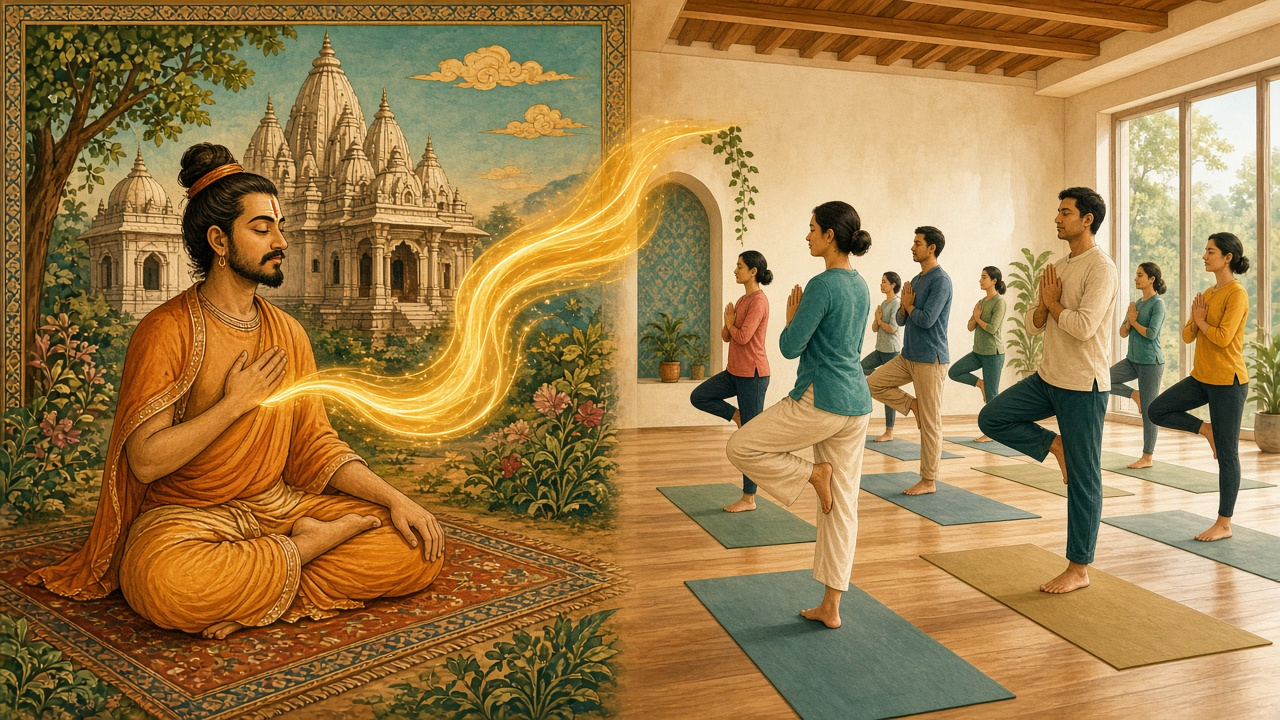
Chakra meditation is one thread of a larger fabric. In the nondual philosophy of Kashmir, a commentary on a classic Shaiva text explains that energy and awareness are never apart and that engaging with energy can be a way into stillness. The chakra practices are one way of engaging with energy in an orderly fashion. Used alongside breath, movement, ethics and reflection, they can contribute to a balanced practice. Used alone as a source of dramatic experiences, they tend to disappoint.
Learning from a teacher
If you are interested in going further, a teacher can help you refine posture, pacing and imagery, and can help you distinguish traditional elements from modern additions. A structured Tantra Yoga programme is one way to find such guidance. The Academy of Modern Tantra describes its Tantra Yoga course as a systematic curriculum supported by contemporary science, taught by experienced teachers who give personal guidance, with flexible study. As always, read the outline, ask about teacher training and check that consent and boundaries are respected.
The takeaway
Chakra meditation can be as simple as resting attention at seven places along the body or as elaborate as combining colour, sound and breath. The simplest forms are often the most useful, because they keep you close to direct sensation. Whatever technique you use, hold it lightly, avoid chasing experiences and treat the framework as a guide rather than a doctrine.
Pick one technique from this article and try it for a week. Keep a few notes. If it steadies you, build on it. If not, change it. The aim is a practice you can return to, not a performance you have to get right.






Leave a Reply