

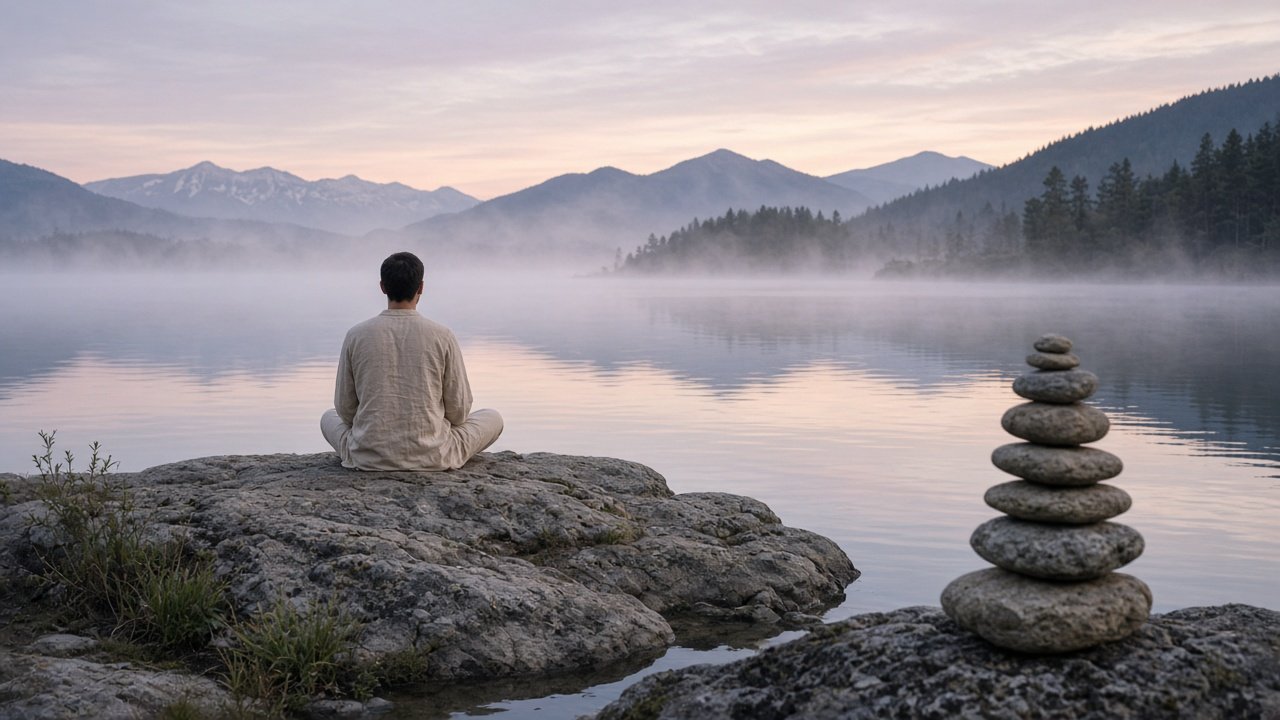
“Balance” is one of the most used and least defined words in wellbeing. We speak of work-life balance, emotional balance, balanced diets and balanced lives, usually as something we lack and should acquire. Underneath the slogan there is a genuine human experience: moments when we feel steady, responsive and at ease, and moments when we feel pulled apart by competing demands, swinging between overdrive and collapse.
Tantra Yoga approaches the question of balance through meditation, breath and bodily attention. Its traditions do not promise a permanent state of perfect equilibrium. They offer methods for noticing imbalance early and for returning, again and again, to a steadier centre. This article explains what inner balance can mean, how Tantric meditation relates to it, and how to build a practice that supports it. It is a general wellbeing guide and does not diagnose or treat any condition.
What people mean by inner balance
When people say they want balance, they usually mean one or more of the following.
Emotional steadiness. Feeling things fully without being tossed around by every wave.
Energy balance. Having enough energy to meet the day without burning out, and the ability to rest without guilt.
Attention balance. Being able to focus when needed and relax when appropriate, rather than being stuck in either scatter or rigidity.
Relational balance. Giving and receiving, speaking and listening, caring for others and for yourself.
Meaning balance. A sense that daily activity connects to something you value.
These are different dimensions, and they interact. Meditation does not solve all of them, but it can strengthen the underlying capacity that all of them rely on: the ability to notice what is happening and respond with some freedom.
Balance is dynamic, not static
A common misunderstanding is that balance means stillness. Think of riding a bicycle or standing on one leg. Balance is the continuous making of small adjustments. A person who looks perfectly steady is usually correcting constantly, often without noticing.
The same is true for inner life. A balanced person is not someone who never feels anxious or angry but someone who notices, adjusts and returns. This is a more realistic and forgiving target than permanent calm.
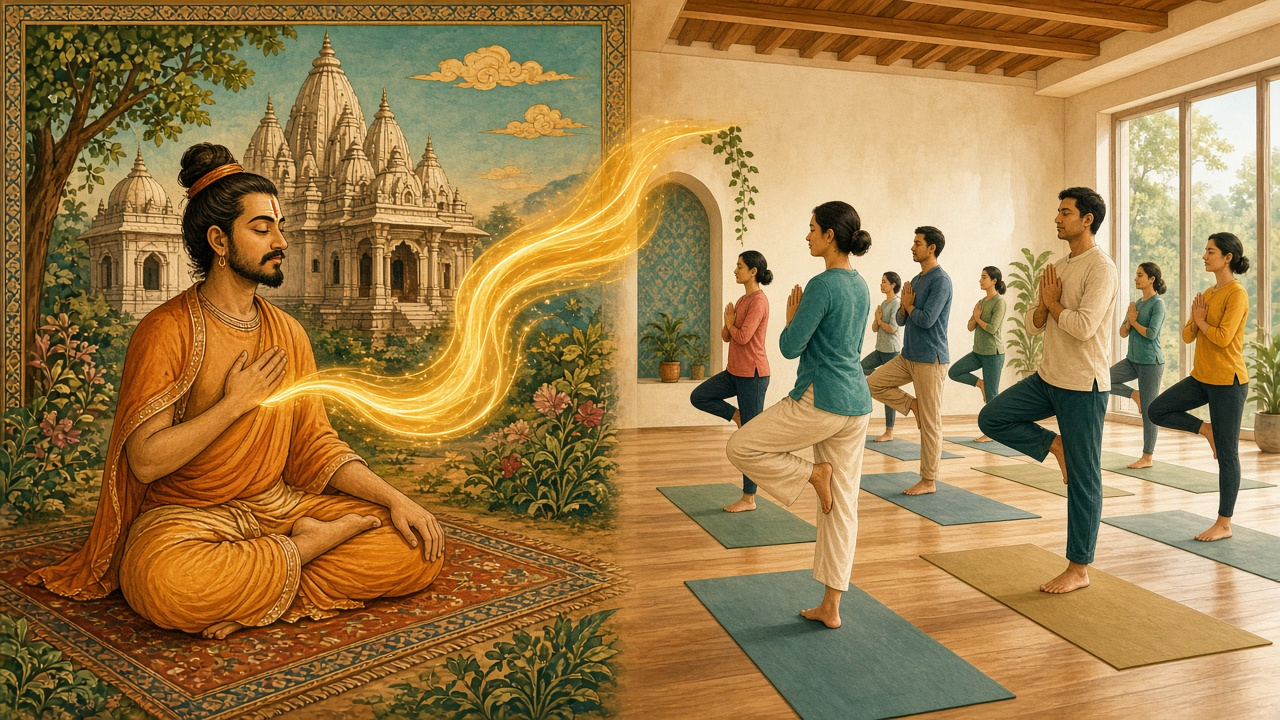
Tantric thought fits this dynamic picture. In the nondual schools associated with Kashmir, stillness and movement are not opposites but two aspects of one reality. A commentary on a classic Shaiva text describes the pair, Shiva as the open ground of awareness and Shakti as its dynamic power, as inseparable. Applied to inner life, the point is that stability and aliveness belong together. You do not find balance by suppressing energy, and you do not find it by being swept away by energy. You find it by being aware of energy as it moves.
How Tantric meditation relates to balance
Tantric traditions developed many meditation methods. The following families are particularly relevant to balance, and all can be practised in simple, secular forms.
Breath awareness
Classical hatha texts treat breath as the link between body and mind. When breath is uneven, the mind often follows. Practising smooth, easy breathing is a direct way to support steadiness. Even simple methods, such as breathing in for four and out for six, are widely used for settling. Keep the breath gentle and stop if you feel dizzy or uncomfortable.
Body-centred attention
Because Tantra regards the body as a path, many meditations rest attention on bodily sensation: the weight of the body, the pulse in the hands, the feel of the belly moving. Sensation is always present, which makes it a dependable anchor when thoughts are turbulent.
Sound and listening
Sound practices, including mantra and simple listening, train attention in a way that is both focused and receptive. Following a sound from its beginning to its fading into silence gives a taste of how experience arises and passes, which can reduce the sense that every state is permanent.
Open awareness
After some practice with anchors, nondual meditation invites a wide, receptive awareness in which sounds, sensations and thoughts all appear within a single field. The doctrine of recognition holds that awareness always knows its own nature, and that practice is remembering rather than acquiring. This can be experienced as a quiet sense of being the space in which things happen, which is itself a kind of balance.
The five elements as a balancing map
Many Tantric and yogic traditions describe five elements: earth, water, fire, air and space. They are not chemical substances but qualities of experience, and they offer a useful vocabulary for noticing imbalance.
- Too little earth may feel like scatteredness or ungroundedness. Too much may feel like heaviness or stagnation.
- Too little water may feel like rigidity or dryness. Too much may feel like drifting or being swamped by feeling.
- Too little fire may feel like flatness or lack of motivation. Too much may feel like irritability or burnout.
- Too little air may feel like stuckness or stale thinking. Too much may feel like restlessness and racing thoughts.
- Too little space may feel like being cramped or overloaded. Too much may feel like emptiness or disconnection.
You do not need to accept this as a literal diagnosis. It is a prompt for asking what quality might help. If you feel scattered, try grounding practices such as feeling the feet. If you feel rigid, try flowing movement. If you feel flat, try something warming and active. If you feel restless, slow the breath. If you feel cramped, step outside and look at the horizon.
A daily practice for inner balance
Here is a simple structure that takes ten to twenty minutes. It can be done in the morning or evening.
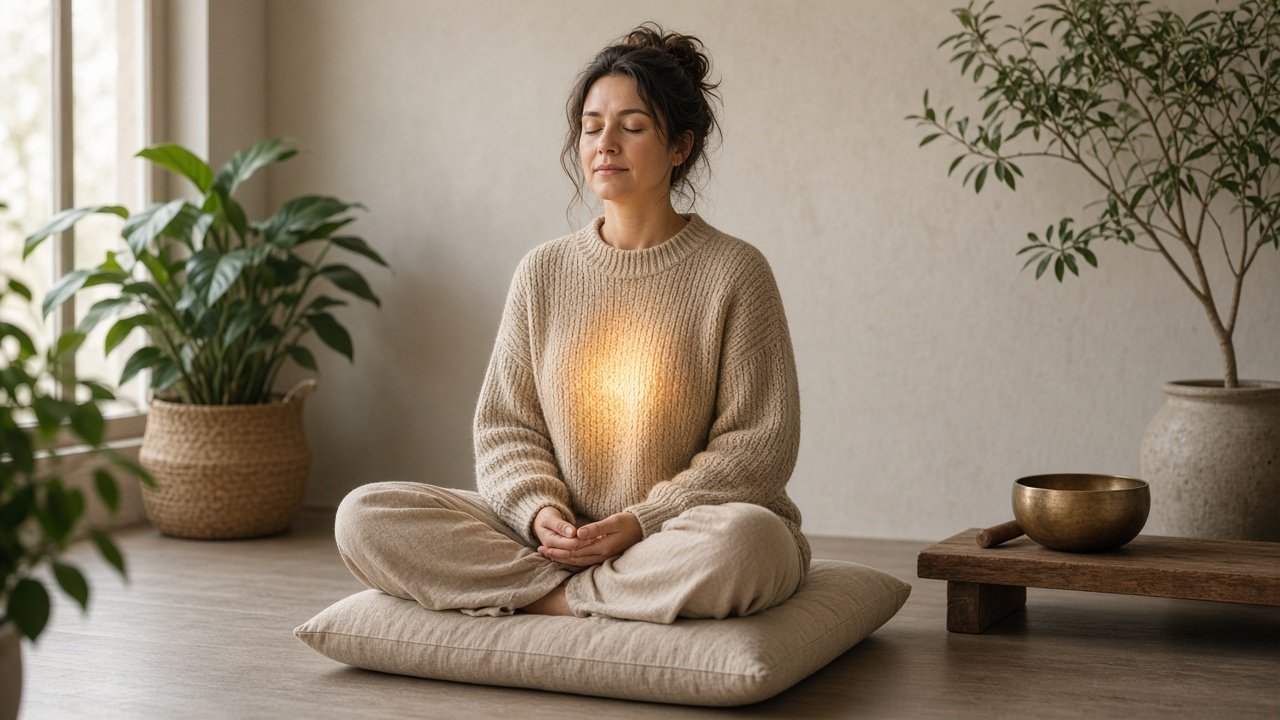
1. Arrive (2 minutes). Sit comfortably. Feel the contact points of the body. Take three slow breaths.
2. Check in (2 minutes). Ask: how am I right now in body, energy and mood? Notice without fixing. If helpful, use the element vocabulary: do I feel more scattered, stuck, flat, restless or cramped?
3. Settle the breath (3 to 5 minutes). Follow the natural breath, or use the longer exhale. Let the body soften with each out-breath.
4. Choose an anchor (5 minutes). Rest attention on the belly, the hands or the sound of the room. When the mind wanders, notice and return.
5. Open (2 to 3 minutes). Let attention widen to include the whole body and the space around you. Rest as the one who is aware.
6. Close (1 minute). Take a deeper breath, move the fingers and toes, and open the eyes. Ask: what do I need most today? Take one small action in that direction.
Balancing effort and ease
In practice, many people swing between trying too hard and giving up. Trying too hard shows up as tension, self-criticism and a desire for results. Giving up shows up as skipping practice or drifting through it.
A useful principle is “steady and soft.” Make the effort to return to the anchor, but make it gently. If you find yourself clenching, relax the face and shoulders. If you find yourself drifting, sit a little more upright and re-engage. This middle path is the practical meaning of balance in meditation.
Balance in relationships and work
Inner balance has outer effects. When you are steadier, you can listen without immediately defending, set limits without anger and ask for help without shame. At work, you can notice rising tension before it becomes exhaustion.
Some micro-practices help:
- Before a meeting, take three breaths and feel your feet.
- During a difficult conversation, pause for one breath before replying.
- After a demanding task, take two minutes to stand, stretch and look out of a window.
- When overcommitted, ask what is essential and what can wait. Practice can clarify priorities but cannot replace honest decisions about workload.
When balance feels out of reach
Some periods of life are simply hard: grief, illness, caregiving, financial strain, burnout. In these times, a perfectly balanced inner life is neither realistic nor required. Practices can help you cope, but they do not remove the need for practical support, rest and, where appropriate, professional care.
Please seek help from a doctor or mental health professional if you experience persistent low mood, severe anxiety, difficulty functioning, or thoughts of harming yourself. Meditation can be a supportive companion to care, but it is not a replacement, and for some people intensive inward practice can be unsettling. It is always acceptable to stop, to shorten sessions, or to focus on gentle, outward-directed attention.
Misconceptions about balance and meditation
“Balanced people don’t get upset.” Everyone gets upset. Balance refers to recovery and perspective, not absence of emotion.
“Meditation should make me calm every time.” Sessions vary widely. Calm is sometimes a by-product, not the goal.
“I should aim for perfect equilibrium.” Perfect equilibrium is neither possible nor necessary. Small, regular adjustments matter more.
“Spiritual practice means rising above ordinary life.” Nondual Tantra emphasises embracing experience and embodiment. Balance is found within life, not outside it.
Learning with support
Inner balance develops through steady practice, and guidance can help you stay on course, particularly when you meet difficulties. A holistic wellness course that integrates breath, body awareness and meditation can provide structure and feedback. The Academy of Modern Tantra describes its courses as taught by experienced teachers who give personal guidance, with a flexible format. As with any provider, review the curriculum, ask about teacher training and check that your boundaries are respected.
A month-long experiment
If you would like to test these ideas, try the following four-week experiment.
Week 1: Foundations. Practise the arrive-and-check-in sequence for five minutes each day. Keep a brief note on your state before and after.
Week 2: Breath. Add five minutes of smooth breathing, with the longer exhale. Notice how breath changes through the day.
Week 3: Anchor and open. Extend to ten or fifteen minutes with the anchor and open awareness steps.
Week 4: Integrate. Choose two micro-practices for daily life, such as three breaths before meetings and a short evening scan. Review your notes. What patterns do you see? Which practices help most?
At the end, decide what to keep. The aim is not to complete a programme but to find a few practices that you can return to when life tilts.
Balance through the seasons of a week
Balance is also a matter of rhythm. Few people can sustain the same pace seven days a week, and trying to do so is a common route to exhaustion. It can help to give the week a shape: a few days of focused effort, a day of lighter activity, and at least some time that is genuinely unscheduled. Notice which days tend to leave you drained and which leave you nourished, and where possible place restorative practices, such as a longer sit, a walk outdoors or an early night, just after the demanding stretch.
A small weekly review can support this. On Sunday evening, take five minutes to ask: when did I feel most steady this week? When did I feel most pulled apart? What was happening each time? What one change might help next week? The answers are rarely dramatic, but they gradually teach you the conditions in which your own balance tends to hold or give way.
Practising with difficult states
Meditation is easy when you feel fine. The real test of balance comes when you are agitated, sad or tired. A few guidelines for those moments:
- Lower the bar. On hard days, a two-minute practice counts as a success.
- Choose a physical anchor. Feel your feet, hands or breath rather than trying to quieten thoughts.
- Allow movement. If sitting is impossible, walk slowly or stretch with attention.
- Name the state. Quietly say “restless” or “heavy” and notice that you can see the state, which means you are not wholly inside it.
- Reach out. Talk to someone you trust if the state persists.
These small acts build confidence that you can stay in relationship with difficult experience, which is a large part of what balance means.
The takeaway
Inner balance is not a fixed destination. It is the ongoing art of noticing where you are and making small adjustments, and meditation is a way of training that art. Tantra Yoga contributes a body-centred, breath-based and non-dual approach, one that treats energy and stillness as partners rather than rivals.
Begin with a few minutes. Feel the body, follow the breath, notice what is out of balance and what is steady. Return the next day. The practice is modest, but its effect accumulates, and it is available whenever you choose to pause.







Leave a Reply