
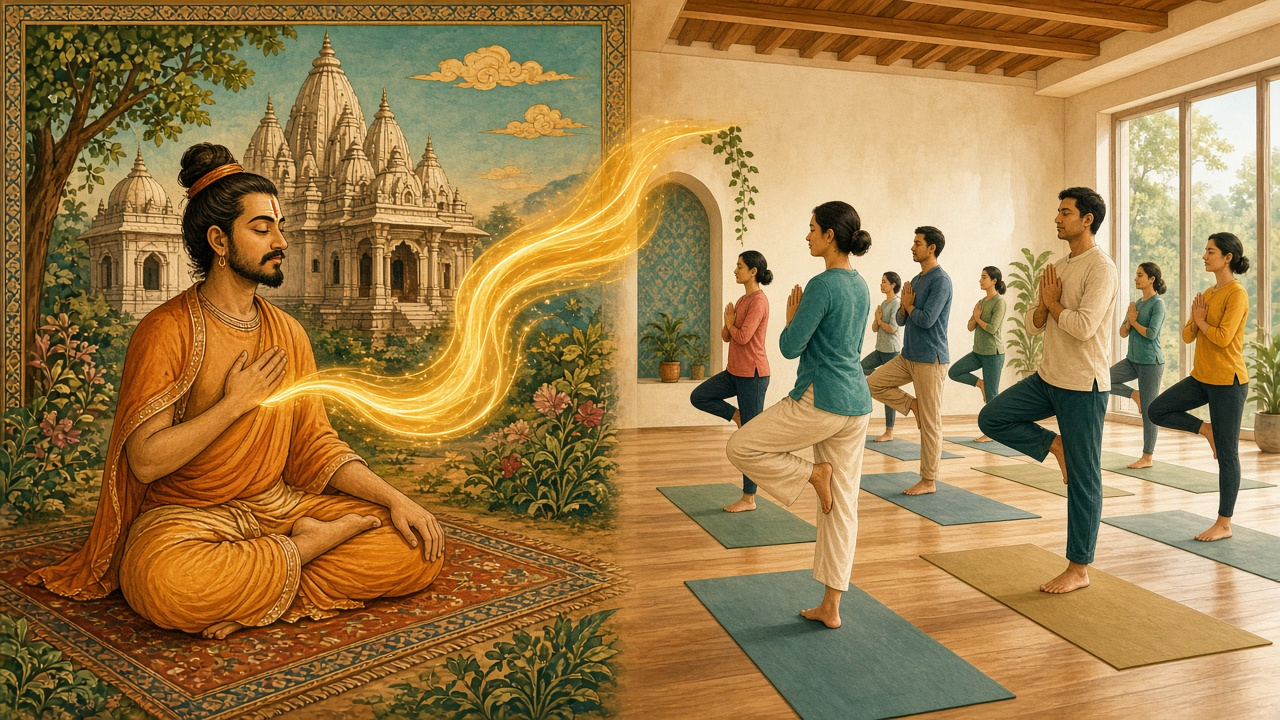
Walk into a yoga class in almost any city and you will find people moving through postures, breathing in time with their movement and learning to settle their attention. Few of them are thinking about medieval Tantric manuscripts. Yet much of what they are doing has a long and surprisingly tangled line of descent from Tantric traditions, mixed with a good deal that is much more recent.
This article separates the two. It looks at what modern yoga inherited from Tantra, what it added or changed in the nineteenth and twentieth centuries, and what that means if you want to choose a class or course with your eyes open. It relies on current historical scholarship, which in recent years has revised some popular stories about where yoga comes from.
The short version
Many of yoga’s core ideas about breath, the energy body and meditation come from Tantric sources through the medieval tradition known as hatha yoga. The modern posture-centred style that dominates studios today, however, took shape mainly in the late nineteenth and twentieth centuries, influenced by physical culture, nationalism and new teaching methods. Both streams are real, and they are not the same thing.
What yoga inherited: the subtle body
Start with what is clearly Tantric. A standard encyclopedia entry describes Tantrism as having developed a sophisticated esoteric anatomy of energy centres, called chakras, connected by channels called nadis. This anatomy is visualised in Tantric yoga, which the same entry divides into two important kinds: mantra yoga and the yoga of kundalini, the dormant energy believed to be awakened and guided upward.
If a class talks about energy flow, breath as vital force, a central channel or a rising energy, it is almost certainly drawing on this Tantric map. These are not ancient universal truths about the body. They are the framework of specific medieval traditions, and the body-based experiences they describe can be explored without adopting every doctrinal claim.
The same source notes that, unlike the earlier Vedic religion, which was ascetic and largely confined to higher castes, Tantrism was based on developing the body and its powers and was open to all castes. The idea that the body is a legitimate instrument for spiritual work, rather than something to be transcended or denied, is one of Tantra’s most important gifts to later yoga.
Hatha yoga: the bridge
The link between Tantra and modern practice runs through hatha yoga. The word hatha is generally translated as “force,” and the system uses physical techniques to preserve and channel vital energy. Those techniques include postures, breath control (pranayama), seals (mudras), locks (bandhas) and cleansing practices.
Research by historians of yoga has clarified the picture. One study reports that the oldest dated text describing hatha yoga, the eleventh-century Amritasiddhi, comes from a Tantric Buddhist setting, and that the earliest uses of the term itself appear in Buddhist Tantric commentaries from roughly the eighth century onward. A twelfth-century text called the Amaraugha is described by its editors as the earliest account of a fourfold system in which physical hatha practice leads to a deep meditative state called rajayoga, with the physical methods having a prehistory in a Tantric Buddhist milieu before being adapted for a Shaiva audience.
The best-known later manual is the fifteenth-century Hatha Yoga Pradipika, compiled by Svatmarama from earlier works. It opens with a salutation to Shiva as the first teacher and names a lineage of masters, among them Matsyendranath and Gorakshanath of the Nath tradition. One Himalayan tradition’s commentary reads this as a deliberate signal of the teaching’s Tantric origin and of the lineage that preserved it.
Hatha yoga was not a single sect. The historian James Mallinson has described it as a broad movement across Indian traditions, available to people regardless of sex, caste or creed, and has compared its spread to the wider democratising trend of the devotional movements. Its manuals generally avoid heavy sectarian metaphysics. That portability helps explain how its methods later travelled so far.
What medieval hatha yoga looked like
It is worth pausing on how different the medieval practice was from a modern class. Here are some features of the classical manuals, drawn from descriptions of the Hatha Yoga Pradipika:
- It emphasises purification practices, breath techniques and meditation, with relatively few postures. One description lists fifteen asanas, many of them seated.
- It presents hatha as preparation for higher meditation, a stairway to a deeper state rather than an end in itself.
- It includes instructions on mudras and bandhas aimed at directing energy.
- It was practised by ascetics and householders within a framework of teacher and lineage.
Compare that with the flowing, strength-focused sequences familiar from modern studios, and you can see that continuity and change both matter.
The modern turn: what historians now say
The best-known recent account of modern postural yoga is Mark Singleton’s book Yoga Body, published in 2010. Its central argument, which scholars have largely accepted, is that the posture-based yoga practised worldwide is mainly a modern development rather than a direct continuation of traditional hatha yoga, with different goals and a far greater focus on asana.
The timeline it describes runs roughly as follows. Before the nineteenth century, European views of yogis and fakirs were often negative, and hatha yogis were frequently seen as disreputable ascetics. In the 1890s, Swami Vivekananda introduced yoga to the West in a form that largely left out postures. From the 1920s onward, an asana-based yoga emerged that stressed health benefits and flowing sequences influenced by the gymnastics of the international physical culture movement.
Several forces shaped this change:
- Physical culture and gymnastics supplied movement sequences and an emphasis on fitness and strength.
- Indian nationalism encouraged posture practice as a way to project national health and vigour in reaction to colonial rule.
- New media, such as photography and printing, changed how poses were recorded and promoted.
- Influential teachers, notably Tirumalai Krishnamacharya at his school in Mysore, developed vinyasa-based approaches that influenced later well-known figures such as B. K. S. Iyengar.
Singleton himself has said that “adaptation” and “reinterpretation” describe the process better than “invention.” Mallinson later found medieval sources that describe more non-seated postures than Singleton expected, though the two scholars have agreed that only a small number of standing poses, such as tree pose, have deep medieval roots. Critics have questioned some of the book’s emphases. The overall picture, a medieval Tantric inheritance reworked by modern influences, remains broadly accepted.
What survived, what changed
Putting the two stories together, you can sort the elements of a typical modern class.
Strongly Tantric in origin
- The idea that breath carries vital energy and can be directed.
- The subtle-body map of chakras and nadis, where used.
- Mudras, bandhas and the notion of kundalini.
- The premise that working with the body can lead to deeper awareness.
- Mantra and sound as meditation.
Largely modern in form
- The emphasis on a wide repertoire of standing and flowing postures.
- Sequencing in continuous vinyasa style.
- Presentation of yoga primarily as fitness or stress relief.
- The standard studio format of group classes.
Mixed or contested
- Claims that particular poses are thousands of years old.
- The description of modern styles as “ancient.”
- The assumption that Tantra and yoga were always separate or always identical.
None of this makes modern yoga fraudulent. Traditions change, and the creativity of twentieth-century teachers produced practices that help many people. The useful lesson is to be precise about what you mean when you say yoga is “ancient.”
Breath: the clearest inheritance
If you want to see the Tantric inheritance in action, look at breath. Classical hatha texts treat breath as the thread connecting body and mind: when breath is steady, the mind steadies, and when the mind is agitated, breath becomes uneven. Techniques of controlled breathing, known as pranayama, are central to the manuals, and they are explicitly tied to the subtle-body map described earlier, in which vital energy moves through channels.
Many modern classes teach a gentle version of the same idea. Slow, even breathing, a brief pause at the top or bottom of the breath, and attention to the sensation of air moving are all common. These simple practices are widely used for relaxation, and they sit comfortably alongside the traditional framework. More forceful breathing techniques are a different matter. They can cause dizziness or anxiety in some people, and a responsible teacher introduces them gradually and invites students to stop whenever they need to.
Meditation and the inner turn
A second inheritance is the emphasis on turning attention inward. Tantric traditions developed an extensive repertoire of meditation methods: following the breath, resting attention on a point in the body, listening to sound, and visualising light or a deity. Hatha yoga absorbed several of these and presented posture and breath as preparation for sustained meditation.
This is a useful corrective for anyone who thinks yoga begins and ends with exercise. In the older picture, the body was prepared so that the mind could settle. A modern class that ends with a few minutes of quiet attention is therefore closer to the original intention than one that finishes the moment the last stretch is done.
Ethics and context
Classical yoga, including its Tantric forms, did not come without a moral framework. Teachers, lineage and restraint were all part of the picture, and many traditions asked students to approach powerful practices with humility. In modern settings, the equivalent is clear communication, informed consent and respect for personal limits. A class or course that explains what you will be doing, offers modifications and encourages you to take only what feels right is following the spirit of the tradition, whatever labels it uses.
“Tantra Yoga” as a label
Given all this, what does a provider mean when it offers “Tantra Yoga”? The phrase can point to several different things.
- A lineage-based path within a particular Shaiva, Shakta or Buddhist tradition, usually involving initiation and long study.
- Hatha and subtle-body practice that draws on the Tantric map of energy channels and centres, taught as a physical and meditative discipline.
- A contemporary holistic programme that translates tantric themes such as breath awareness, mindful movement and mind-body integration into a modern framework.
None is inherently superior. What matters is transparency about which one you are being offered. A modern course that says clearly it is an adaptation is easier to trust than one that promises an unbroken ancient transmission.
Choosing a class or course
Here are some practical pointers drawn from the history above.
Ask about the lineage or influences. Teachers who can name their sources and training are usually more reliable than those who rely on vague references to antiquity.
Look for breadth. A programme that includes breath, meditation and philosophy alongside posture is closer to the original shape of the tradition than one that is only about movement.
Expect progression. Classical hatha treated postures as preparation. A good course introduces them gradually and explains their purpose.
Respect your limits. Breath practices and strong energy techniques can feel intense. Qualified teachers introduce them carefully and offer alternatives, and anyone with health concerns should check with a professional first.
Be wary of exaggerated claims. Phrases like “scientifically proven to awaken” or “the only authentic method” deserve scepticism.
Where to go from here
If you would like a structured introduction to Tantric ideas as they relate to yoga, a guided Tantra Yoga course is one option. The Academy of Modern Tantra describes its Tantra Yoga course as a systematic curriculum supported by contemporary science, and it emphasises personal guidance from experienced teachers and flexibility in how students study. You may want to compare any such offering with the questions above, ask about teacher qualifications and read the course outline before deciding.
The takeaway
Modern yoga is neither a pure ancient transmission nor a purely modern invention. Its understanding of breath, energy and the body as a path to awareness has deep Tantric roots, passed down through hatha yoga from the medieval period. Its familiar posture-centred form took shape much more recently, shaped by gymnastics, nationalism and gifted twentieth-century teachers.
Seeing both layers does not diminish the practice. It makes you a more discerning student. You can enjoy a vigorous class for what it is, explore the quieter breath and meditation methods that carry the older inheritance, and recognise honest teaching when you meet it. In yoga, as in any living tradition, knowing where things come from is a good way to decide where to go next.






Leave a Reply